





-01.webp?width=400)




Over the past decade, we have seen an increase in externally managed fund (EMF) programs at community foundations. In fact, in FEG’s 2025 Community Foundation Survey, 81% of respondents allow donors to work with their personal investment advisors, up from 60% a decade ago, with the average foundation reporting 17 EMFs.
EMF Program Size Differs By Community Foundation Size
Number of Externally Managed Funds
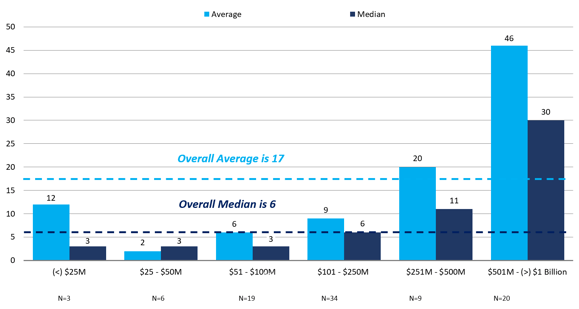
Source: FEG's 2025 Community Foundation Survey
This increase brings opportunity but also additional oversight and workload that must be balanced. We will delve into the history of EMFs and discuss four key steps to designing an EMF program for community foundations.
What Is an EMF and Why Community Foundations Are Adopting Them
An EMF is a fund held at the foundation and managed by the donor’s external investment advisor under foundation oversight. Community foundations have developed EMF programs for a number of reasons.
Donors are able to give to their community while maintaining continuity with their advisors. Advisors remain a key part of the philanthropic discussion and can help spread awareness of the foundation to their clients. Foundations retain or attract assets that might otherwise be given to another nonprofit or not donated at all.
However, as adoption has increased, so have the operational demands on the foundation. Each additional advisor relationship introduces incremental complexity for staff and investment committees. Staff must coordinate onboarding, reporting, and documentation. Investment committees must oversee multiple portfolios that may differ in structure and risk. Clear program standards around advisor eligibility, monitoring, and exceptions become essential. Without that structure, programs tend to evolve informally, which can limit scalability and consistent oversight.
Whether a foundation is considering launching an EMF program or reassessing an existing one, the central question is the same: how should the program be structured so that it remains manageable and consistent with fiduciary responsibilities?
The four-step framework that follows outlines practical steps for building or refining an EMF program.
Step 1: Align Governance and Expectations
Before drafting policies or debating minimums, foundations need clarity around purpose and responsibility. EMFs affect board oversight, committee workload, and staff capacity. Those implications should be discussed openly at the outset.
In practice, these conversations surface different priorities. Boards and development staff often focus on expanding grantmaking capacity and responding to donor or advisor interest. Finance staff tend to focus on operational realities—additional accounts to onboard, monitor, and report on. Investment committees want clarity around risk, exceptions, and the scope of fiduciary oversight.
Foundations that move deliberately often convene a working session that includes board leadership, members of the investment committee, and senior staff before launching or expanding an EMF program. The discussion typically centers on three questions: Why are we offering EMFs? What level of flexibility are we prepared to accommodate? Who is responsible for oversight and exception decisions?
Some foundations choose to pilot the program with one or two funds before broader rollout. A pilot can clarify workload, test reporting workflows, and reveal documentation gaps without committing the organization to full-scale implementation.
Without early alignment, EMF programs can develop through a series of ad hoc exceptions. Over time, that pattern can strain limited staff resources and make it more difficult to scale the program in a consistent way.
Sometimes the timing is not right for adding EMFsOne foundation we spoke with was approached by a local advisor interested in directing a donor to the community foundation, provided the advisor could continue managing the assets. Leadership saw the potential for additional grantmaking. The board also recognized the opportunity, but paired it with a practical concern: the foundation had two full-time staff members and no experience administering EMFs. After discussion, leadership concluded that the concept was sound, but the timing was not. The foundation chose to revisit the idea when staffing and processes were better aligned with the demands of the program. |
Step 2: Establish Program Standards
Once governance alignment is in place, the next task is to codify the program’s standards. Most foundations rely on three primary tools:
1. A formal advisor application
2. Documented program guidelines
3. A dedicated EMF Investment Policy Statement
Advisor Application
The advisor application establishes eligibility criteria and sets expectations at the outset. It typically addresses regulatory standing, professional experience, disciplinary history, reporting commitments, and agreement to comply with the foundation’s guidelines. A written application creates consistency and reduces pressure for case-by-case accommodations.
Program Guidelines
Program guidelines outline the structure of the offering. These documents clarify minimums, fee treatment, custodian expectations, reporting frequency, and oversight responsibilities. They should also address how minimums apply, for example, whether each fund must meet the threshold independently or whether related funds may be aggregated. The decision has implications for accessibility, administrative complexity, and oversight discipline.
EMF Investment Policy Statement
A standalone EMF Investment Policy Statement is a related but distinct document. Foundations are often asked whether their primary endowment IPS can simply be extended to cover EMFs. In most cases, a separate policy is advisable. Governance structures and liquidity expectations differ, and investment approaches appropriate for pooled endowment assets may not translate cleanly to advisor-managed accounts.
| In one instance, a foundation had several advisors reference allocation targets from the primary endowment policy; however, their allocations in practice diverged. Mainly the differences were because of a higher liquidity need (and thus higher fixed income allocation) and values alignment. To fix the inconsistent implementation, the foundation moved to a standalone EMF IPS. The change did not alter the foundation’s investment philosophy, but it clarified which standards applied and eliminated recurring confusion. |
Another early policy decision when launching, or revisiting, a program is to determine whether there is a minimum amount that will need to be donated for an EMF. Minimums directly affect participation and administrative burden. There is no universal standard, and the threshold ranges greatly, although in the FEG 2025 Community Foundation Survey respondents had a median minimum of $500,000. We believe foundations should set minimums with a clear understanding of staff capacity, reporting expectations, and committee workload.
EMF Program Minimums Vary Greatly
Respondents had minimums as little as zero and as much as $10 million
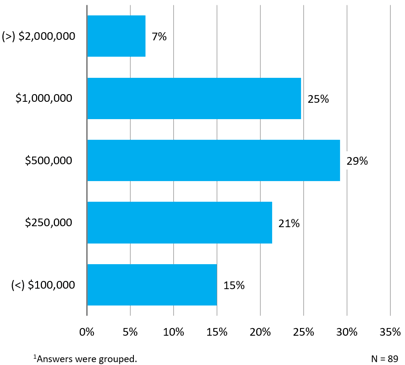
Source: FEG's 2025 Community Foundation Survey
Taken together, the application, program guidelines, and EMF-specific IPS define the program’s structure.
Step 3: Operationalize the Program
Once standards are documented, attention shifts to day-to-day execution.
Foundations need a defined process for bringing advisors into the program, opening accounts, collecting reports, and maintaining records. When these steps are informal, responsibility can drift and documentation becomes inconsistent. A clear, repeatable approach reduces dependence on any one staff member and supports continuity over time.
Bringing advisors into the program often requires a lot of meetings with them. Many foundations hold annual lunch sessions for advisors to attend and learn about the foundation and the EMF program. Once an advisor has a client interested in an EMF, they will work with staff to set up the account. This process differs among foundations, but it is important that there is a process and training for the advisors. This ensures that advisors are aware of what reporting will be expected, along with any timelines.
Responsibility for collecting reports and maintaining records should be clearly assigned. Some foundations handle this internally while others rely on their investment committee or the foundation investment advisor. The key is that someone is accountable and able to ensure there are regular reports from the EMF advisors.
Data management becomes more important as the number of EMFs increases. Reviewing accounts across multiple custodian portals or through separate advisor PDFs is workable at small scale but difficult to sustain as the program grows. Consolidated reporting, managed internally or through a service provider, allows for more efficient review and clearer committee reporting.
In practice, foundations often refine their approach as the program evolves. One foundation with an established EMF program initially required all advisors to use a single custodian to simplify reporting. The structure provided clarity, but it also limited participation, as several advisors were unable to work with the mandated custodian. As the program matured, the foundation broadened its custodian policy and implemented centralized data aggregation to support consistent monitoring across platforms. The change expanded advisor participation while preserving oversight discipline.
Periodic reinforcement of expectations is also important. Staff and committee members benefit from clarity around review responsibilities, and advisors should receive regular reminders of reporting timelines and IPS requirements. As personnel change, written procedures and consistent communication help maintain continuity.
Programs that scale successfully tend to have clear, repeatable processes.
Step 4: Maintain Ongoing Oversight
When external advisors manage charitable assets, the foundation retains fiduciary responsibility. Ongoing oversight should reflect that obligation.
Oversight begins with regular review of performance and asset allocation relative to the EMF Investment Policy Statement. The objective is not to evaluate individual security selection, but to confirm that portfolios remain within established guardrails, align with the foundation’s risk parameters, and ensure that any deviations are addressed in a consistent manner.
Performance dispersion can occur even among portfolios that follow similar allocation guidelines. Differences in implementation, manager style, and security selection may produce materially different outcomes over time. Oversight frameworks should account for that reality.
Setting performance review standardsOne foundation with approximately $75 million in externally managed assets across ten funds observed meaningful performance variation among advisors following similar allocation targets. Rather than reacting to short-term results, the foundation established defined performance review thresholds tied to rolling multi-year periods. Underperformance beyond a specified range relative to policy benchmarks would prompt additional review, documentation, and dialogue with the advisor. “Watch” status in this context did not imply termination; it signaled the need for structured follow-up. |
Foundations should maintain records of reporting timeliness, allocation exceptions, and related follow-up to provide continuity as staff and committee membership evolve.
Regulatory considerations remain part of the oversight landscape. Because EMFs often mirror donor-advised fund structures, they are subject to many of the same IRS and Treasury rules. Foundations should review agreements and policies periodically and consult legal or tax counsel when regulatory developments materially affect program structure.
Effective oversight depends on clear roles, regular review, and documented follow-up.
Closing Thoughts
When implemented thoughtfully, EMF programs can help advance community foundations’ objectives. But they can also create strain if expectations and infrastructure are not aligned. Below are the key takeaways from each step in the process.
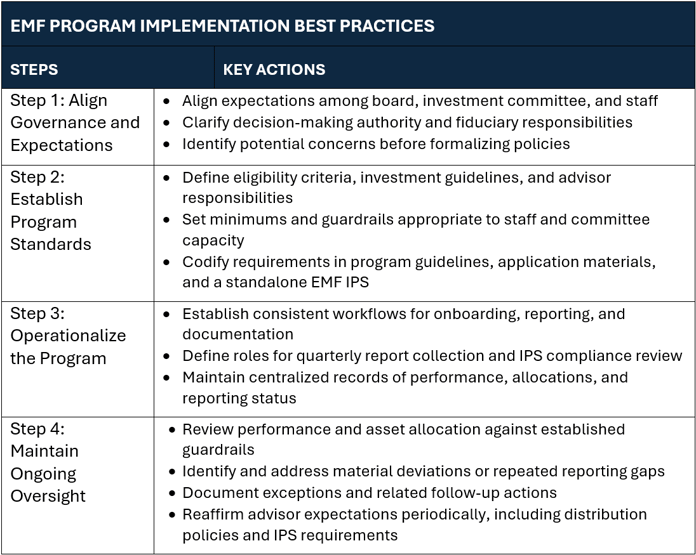
In our experience, the foundations that run durable EMF programs are the ones that take time up front to define roles, document standards, and build processes that match their capacity.
For foundations considering an EMF program, or reassessing an existing one, a few questions are worth asking:
-
Are roles and fiduciary responsibilities clearly defined?
-
Are eligibility standards and IPS guardrails documented and consistently applied?
-
Do we have the staff and committee capacity to monitor the program as it grows?
-
Are deviations and performance concerns addressed in a structured way?
The work is not complicated, but it does require discipline.
FEG works with community foundations to design and refine EMF programs that are aligned with governance standards and operational capacity. If you would like sample templates, policy examples, or an independent review of your current program, we welcome the opportunity to connect.