




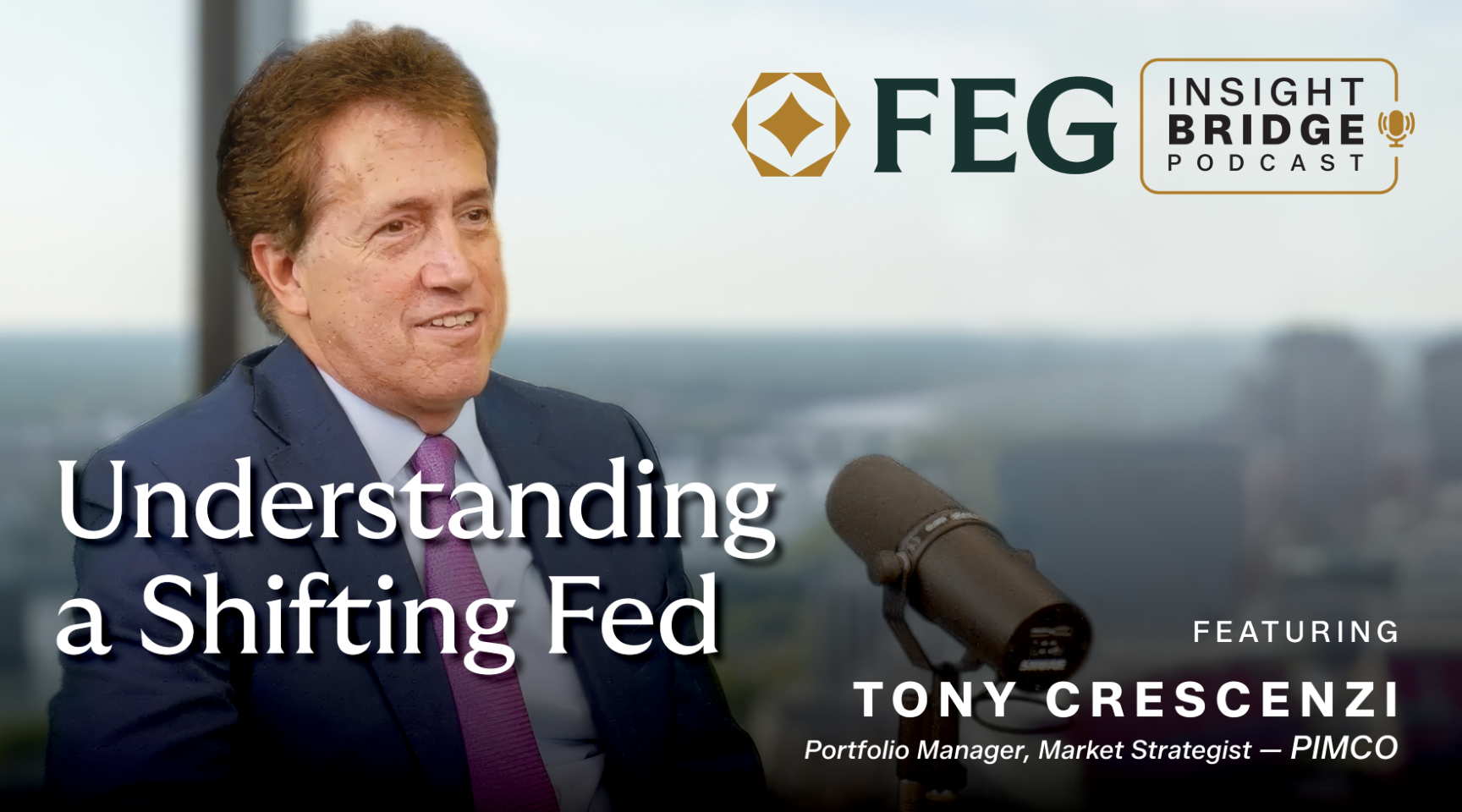


Karthik Ramanathan joins the FEG Insight Bridge Podcast to explore the intricate, often misunderstood relationship between the Federal Reserve and the U.S. Treasury.
Host Greg Dowling sits down with Karthik Ramanathan, former Director of the U.S. Treasury’s Office of Debt Management, for a behind-the-scenes look at how the Treasury and the U.S. Federal Reserve intersect. From managing trillions in debt issuance to coordinating with the Fed around day-to-day policy execution as well as crisis event triage, Karthik shares firsthand insights into how Treasury decisions shape U.S. financial stability and global market dynamics. The conversation covers auction strategy, debt management, and the delicate balance between independence and collaboration—especially in times of economic and political stress.
Get an insider’s look at how leading U.S. financial institutions navigate today’s complex global financial system.
Key Takeaways:
- The Fed and Treasury operate independently, but their actions are deeply intertwined, and not only during times of crisis—highlighting the importance of understanding their respective mandates and coordination mechanisms.
- Debt issuance and interest rate policy are not just technical tools—they shape market liquidity, investor behavior, and economic stability.
- Debt management is strategic. Decisions on maturity, timing, and auction design help manage liquidity, investor confidence, and fiscal stability—especially in volatile markets.
- Fed-Treasury coordination is crucial and systematic necessity. During crises, they must collaborate to stabilize markets while preserving their independence and distinct mandates.
Episode Chapters
| 0:00 | Podcast Introduction |
| 1:32 | Welcome Karthik Ramanathan |
| 2:22 | U.S. Treasury 101 |
| 3:35 | Karthik’s Journey to the Treasury |
| 4:15 | Leading the Office of Debt Management |
| 4:48 | Navigating the Great Financial Crisis |
| 5:57 | Lessons Learned |
| 6:22 | Interaction Between the Treasury & the Fed |
| 8:36 | Impact of Borrowing on the Fed |
| 11:08 | Treasury’s Petty Cash |
| 11:43 | Optimal Financing—Regular & Predictable |
| 13:28 | Why Invest in U.S. Debt? |
| 15:43 | Can Treasury Auctions Fail? |
| 19:08 | Independence at the Treasury? |
| 20:36 | Effects of Tariff Revenue |
| 22:10 | Political Pressure on the Fed |
| 24:47 | Impact of Federal Shutdowns on Treasury |
| 26:08 | You’re Fed Chair—Now What? |
| 28:36 | Outlook for 2026 |
| 30:42 | Possibility of a U.S. Sovereign Wealth Fund |
| 31:47 | Privatizing Social Security and Potential Impact |
| 33:48 | Payden & Rygel’s Fixed Income and Credit Outlook |
| 35:28 | Karthik’s Reading List |
| 36:15 | Lightning Round |
SPEAKERS
Greg Dowling, CFA, CAIA
Chief Investment Officer, Head of Research, FEG
Greg Dowling is Chief Investment Officer and Head of Research at FEG. Greg joined FEG in 2004 and focuses on managing the day-to-day activities of the research department. Greg chairs the firm’s Investment Committee, which approves all manager recommendations and provides oversight on strategic asset allocations and capital market assumptions. He is also a member of the firm’s Leadership Team and Risk Committee.
Karthik Ramanathan, CFP
Senior Vice President, Payden & Rygel
Karthik Ramanathan is a Senior Vice President at Payden & Rygel. He serves as a Senior Client Portfolio Manager focused on US and global institutional clients and is based in Boston. Prior to joining Payden & Rygel, Karthik was a senior vice president in State Street's global client division. He focused on institutional clients as senior vice president and director of bonds at Fidelity Investments from 2010 to 2018.
Karthik served as director of the Office of Debt Management and acting Assistant Secretary for Financial Markets at the U.S. Department of Treasury from 2005 to 2010. He began his career at Goldman Sachs within the Mergers and Acquisitions Group as a banker before joining the Foreign Exchange Division as a currency trader. Karthik earned his degree in Economics and Mathematics at Columbia University. He has contributed to various publications and sat on committees including the Journal of Portfolio Management Advisory Board and the Institute of International Finance Market Monitoring Group.
Transcript
Greg Dowling (00:06): Welcome to the FEG Insight Bridge. This is Greg Dowling, Head of Research and CIO at FEG. This show spans global markets and institutional investments through conversations with some of the world's leading investment, economic and philanthropic minds to provide insight on how institutional investors can survivor and even thrive in the world of markets and finance. On today's Insight Bridge, we are doing a deep dive on the Federal Reserve and the Treasury Department. What are their unique roles, and how do they interact? How do debt and deficits impact The Fed? Can a Treasury auction fail? What is the impact of tariffs? And, finally, politics and what we should be watching for in the coming year. Helping us make sense of it all is Karthik Ramanathan. Karthik worked at the U.S. Treasury from 2005 to 2010 as the Director of the Office of Debt Management and Acting Assistant Secretary for Financial Markets. He is currently a Senior Vice President and Client Portfolio Manager at Payden and Rygel, 160 billion fixed income manager based in Los Angeles, California. Karthik and FEG have had a long relationship. Karthik was one of our FEG Forum speakers in 2012 along with Jeffrey Gundlach, T Boone Pickens and Jim Grant. He was a fan favorite. We think you'll be not only educated but entertained. Karthik, welcome to the FEG Insight Bridge. Would you please introduce yourself and Payden?
Karthik Ramanathan (01:38): Thanks, Greg. Thanks for having me today. My name is Karthik Ramanathan. I'm a Client Portfolio Manager at Payden and Rygel. Payden manages fixed income assets for institutional clients around the world. Our founder, Joan Payden, started the firm 43 years ago, and we've been growing ever since. We think our firm is in this real sweet spot, not too large to move the market but not too small to be ignored and really enjoying this experience, especially focused on fixed income.
Greg Dowling (02:04): That is fantastic. There is a lot going on in the world today, especially with our financial institutions, and we're going to lean pretty heavily on some of your past experience to try to make sense of what's going on in the world in terms of the Treasury and The Fed and how they interact. So maybe we'll have to start with the basics. What does the Treasury do?
Karthik Ramanathan (02:27): Greg, that's a great question, because there's oftentimes quite a bit of confusion about what the Treasury does, what The Fed does. The overarching role of the Treasury is to maintain a strong economy and create economic and job opportunities. Accomplishing these goals, though, means its responsibilities are incredibly vast. Most people know that the Treasury oversees the IRS and debt issuance, but it's also responsible for the U.S. mint, the Bureau of Engraving, the Office of Comptroller and FinCEN, the Financial Crimes Enforcement Unit. Only the Treasury can speak publicly about the dollar. There are a lot of items that Treasury does that differ from The Fed's function. Now, on the Fed side, it's the Central Bank. It conducts monetary policy and has a dual mandate: Maximize employment, and keep prices stable. It also supervises and regulates banks, facilitates the movement of money and executes FX tractions on behalf of the Treasury. So two different institutions, different sets of responsibilities, but oftentimes they actually overlap, as well.
Greg Dowling (03:28): Yeah, and we're going to talk more about that. In talking to you kind of prepping for this, you worked Treasury and The Fed, who kind of work hand in hand. But it may be interesting for listeners to hear, how did you end up there? What was your career path that led you to the Treasury?
Karthik Ramanathan (03:43): I started my career at Goldman Sachs in 1994 as a banker in their mergers and acquisitions group. One of my heroes there who had just left actually was Bob Rubin, who left Goldman and became the NAC Chair and Treasury Secretary in the late '90s. It was one of the reasons I moved on from being a banker to a foreign exchange trader, because Bob Rubin was one when he was at Goldman. I always wanted to work in Washington, and the real impetus to change rules came after 9/11. I was very fortunate, spoke to many people, mailed out letters, found an interesting role and went to DC in 2005.
Greg Dowling (04:16): And what did you actually do? Did you run, like, the printing press? What was your role with the Treasury?
Karthik Ramanathan (04:20): I was Director of the Office of Debt Management from 2006 to 2010. My job was to issue the debt of the United States. In 2008, actually September of 2008, I was designated Acting Assistant Secretary for Financial Markets and worked on many of Treasury's rescue programs including TARP and the GSE conservatorship. I also had the privilege of maintaining relationships with reserve managers and large investors around the world, basically the customers of Treasury.
Greg Dowling (04:48): So 9/11 kind of started your path to the Treasury, but when you're there, you're there during the great financial crisis. What was it like to be at the Treasury during that time? That must have been incredibly stressful but also, kind of looking back, an amazing experience.
Karthik Ramanathan (05:04): I was privileged to work with a cadre of really talented individuals. Remember, the crisis started in August of 2007, really, as some of those structured investment vehicles started to implode. The following summer, we worked on moving Fannie Mae and Freddie Mac into conservatorship. It was a massive undertaking at the time. Quick fact, Greg, the MBS buying program was actually started by Treasury, not the Federal Reserve. After the GSEs were put into conservatorship, Treasury was in the market in September of 2008 buying mortgage-backed securities to support the market and calm investors. Of course, The Fed's program came online in November of 2008. There were times when the Treasury markets stopped functioning like in October 2008. All in all, I appreciated the people I worked with and the experiences, but I think my time in civil service has come to an end. Time to move on to new things, and I was fortunate to leave in 2010.
Greg Dowling (05:59): Any lessons learned from your time during the great financial crisis?
Karthik Ramanathan (06:02): History repeats. We've had banking failure since. We've had runs on money market funds since. We've had tremendous stress in Treasury repo markets. I think the key lessons are, be prepared. Have a playbook. Know what was done in the past, and oftentimes you can look at what you did in the past and make it through whatever crisis you're focused on.
Greg Dowling (06:22): We're going to kind of take your experience from there and help us, the listeners, kind of understand what's happening today. And maybe the first kind of step to that would be, how do the Treasury and The Fed interact? What sort of relationship do they have?
Karthik Ramanathan (06:39): The Treasury and Fed work incredibly closely together on many, many issues, both international, domestic. You name it. From a purely operational perspective, the Treasury collects all the revenue and makes payments to the tune of hundreds of billions of dollars a day. And The Fed, in many ways, acts as the piping between the Treasury and financial institutions. Importantly, the U.S. Treasury makes decisions on debt issuance and auctions to those securities, and the Federal Reserve works with primary dealers and helps maintain stable markets. They jointly monitor the Treasury market and other financial markets to make sure it's stable. That's really critical, more critical given the massive borrowing needs out there. For example, every once in a while, the Treasury will call for a large position report. That is any investor holding over 10 percent of a specific Treasury security on a given date has to let Treasury know. That's to prevent bad actors from cornering or squeezing the market by owning too much of a security. That's what happened in 1999 when the investment bank Solomon Brothers bought over 35 percent of a specific issue. So The Fed, Treasury, as well as the CFTC and SEC work incredibly closely to make sure the Treasury market functions well because that's so critical for our national security.
Greg Dowling (07:54): Do they have formal meetings, or do they meet up at the local DC coffee shop? How do you guys communicate?
Karthik Ramanathan (08:02): I know in the past that as well as even now the Treasury secretary as well as the chairman of The Fed regularly meet for breakfast. Teams within the debt management offices as well as The Federal's open market desk speak very regularly. It's not just once or twice a week. It's multiple times a day, and that communication is so critical.
Greg Dowling (08:25): That's interesting. You assume they probably talk, but you just don't know. That's pretty interesting, that there's probably somebody from each of these departments talking on an almost daily basis. You mentioned it earlier, and I think everybody knows, that the has lots and lots of debt. We're able to run large deficits because our economy is so dynamic but also that we're the reserve currency of the world, and that kind of bears some special privilege. But how does Treasury -- When Treasury goes out and borrow, how does that impact the Federal Reserve?
Karthik Ramanathan (08:58): That's a very good question, and actually there is a much bigger impact than many realize. When the Treasury issues debt, financial institutions purchase that in the market. And that actually drains liquidity from the system. When debt matures, it's a liquidity boost. More broadly, The Fed can conduct monetary policy by buying and selling government securities in the market. So there's a really delicate interplay. They monitor those market conditions and act to maintain a stable Fed funds rate. They're incredibly interconnected to ensure that this $900 billion Treasury market in terms of volume functions efficiently. What's interesting, and you think of policy, Greg, I'm going to let you in on a little secret.
Greg Dowling (09:41): All right. I'll be very quiet on this one.
Karthik Ramanathan (09:44): Don't tell anyone, but the Treasury is in the monetary policy business, too, and this is where, when we think about independence or crossovers or policy, I like to call it stealth monetary policy. And let's discuss how that works. The Treasury takes about $800 billion in its checking account.
Greg Dowling (10:02): Wow.
Karthik Ramanathan (10:03): That's called the Treasury's general account. Back when I was at Treasury, we would try to maintain $5 billion. But it's just-in-case money, in case the Treasury couldn't raise money for some reason or other. For some short period of time, they would be able to drain this checking account. When it spends down that balance, it's creating luciding condition. This usually happens when tax refunds are made or before we go into a debt ceiling when the Treasury has to stop issuing debt. It's stealth quantitative easening. On the other hand, when the Treasury checking account rises like it does when corporations make tax payments in April, June, September and December, it's tightening conditions in the market, and this is the size of the stealth monetary policy, can be enormous and can impact rates. That's why so many professionals start to look at the Treasury's general account, its checking account balance, to get a sense of where rates might go. And again, this is in context. The Fed, of course, knows about this. The Treasury is working hand-in-hand with them. But it's another measure that maybe investors should be looking at almost on a daily basis.
Greg Dowling (11:09): Interesting. That's not something I was fully aware of, and I've also got to tell you that, in my petty cash, my checking account, I don't keep that much money around. So maybe I should. I'm not sure.
Karthik Ramanathan (11:20): That concern or that $800 billion actually went from $5 billion to $300 billion right after 2011, 2012, just before S&P downgraded the United States, and there was real concerns at that point about how you would pay your bills. And since then, it's just risen, and I think this, given the massive size of payments and interest payments, it's needed.
Greg Dowling (11:42): Wow. So is the Treasury financing itself in an optimal way? Everything is very short-term. You see other countries, and especially you saw this during the ZIRP, zero-interest-rate policy, globally that countries would issue a 100-year bond, and we don't. And so give us some thoughts on the optimal financing and maybe why the Treasury does it the way they do it.
Karthik Ramanathan (12:06): The Treasury's modus operandi -- I'm using a big word there -- is to be regular and predictable. But behind that simple slogan is a really highly sophisticated process that they go through. A lot of the fiscal year, the Treasury conducted 435 auctions across 17 different securities, both nominal and inflation-linked. And that resulted in the issuance of over $22 trillion of debt. Think of that: 435 auctions. That's more auctions than days in a year. Sometimes the Treasury might have three or four auctions in a given day. They try not to do them on Fridays. They definitely don't do them Saturdays and Sundays. In addition to that, the Treasury conducts over $200 billion in buy-backs to improve liquidity in the market. That is, it's buying illiquid off-the-run Treasuries and trying to replace them with more liquid securities. That helps improve market efficiencies. It's a really massive undertaking, and they've done a really admirable job, both from a policy perspective as well as an operational perspective. Now, let me step back in terms of the debt. Thirty percent or so matures within the coming year, and while we might say the debt maturity profile is about 6 years from now for the US, yes, there's quite a bit of short-term debt out there. But there's still demand for that from a lot of different sources.
Greg Dowling (13:29): Why would people want to buy all this debt?
Karthik Ramanathan (13:31): There's a few points. One, there is no other market that offers this liquidity. When you are a stable coin issuers, and most recently the Treasury approved this GENIUS legislation, which --
Greg Dowling (13:43): Yeah, GENIUS Act, David Sachs, yeah.
Karthik Ramanathan (13:45): Yeah, and they essentially need to buy Treasuries as backing. That's short-term debt. Many banks and institutions want to keep a large chunk of their assets in highly liquid cash. And then most recently, given rates were higher, there was a lot of demand for that front end of the curve. Now, that might change over time, but there are buyers out there for this security. Let me step back and also say the biggest holders, Japan with over 1 trillion, China, which had over $1 trillion in assets, and it's now at about $750 billion. Other countries have come in and taken their place in terms of buying an investor demand. The UK, for example, which is a proxy for hedge funds, or Canada, which, I didn't realize actually, I had to look this up and double-check, has about $350 billion in Treasuries. So there are new buyers in the market compared to previous ones. Now, you asked a good question: Would they ever do a 50 or 100-year offering? I think eventually they will. Interestingly, Secretary Bessent in June said he wouldn't issue long-term debt at current interest rates. That was quite different from typical Treasury policy, which doesn't try to time market. So as a result, you would expect Treasury yield curves, especially on the back end, remain steep because of the anticipation of more long-term issues. It's also interesting, every Treasury secretary has come out and done a study, should we issue 50 or 100-year debt? There's just a lot of risk at the auction in terms of duration. Sure, there are 25 primary dealers out there who have to bid in these auctions. But new securities take a long time to be adopted, and those risks far-outweigh maybe at this time issuance. At the same time, when our liabilities are extending out decades, it could make sense. I will say one thing, Greg. Where in the auction calendar would you issue this debt? I don't want to be bidding on 50-year debt or 100-year debt on a Saturday or Sunday.
Greg Dowling (15:37): Yeah. I can see that. I don't know. Probably, what, Monday? So you could do it Monday.
Karthik Ramanathan (15:40): We already have three on Mondays. We already have three at least on Tuesday.
Greg Dowling (15:43): Geez. It's full, and it get sot your question about primary dealers and then also these auctions that take place and, to your point, sometimes a number of times per day. Can a Treasury auction fail?
Karthik Ramanathan (15:56): It's a fantastic question that often is asked, and I think really the point that I would like to make is, the biggest risk is not a lack of demand. The biggest risk for Treasury is an operational issue during an auction. There are 25, as I mentioned, broker/dealers currently that have been appointed by The Fed. Each of those dealers is expected to participate meaningfully in those auctions. And The Fed keeps a close eye on what each dealer bids and evaluates the performance on a quarterly basis. They're not bidding enough, they're going to get a talking-to. So there could be lower investment demand, at least to a tail, that is a move higher in interest rates at an auction. However, at some price, the auction will clear. And so there are also other levers that the Treasury and The Fed can lean on, and over time, that could be, like I mentioned, the stablecoin legislation will increase demand for Treasuries. The supplementary leverage ratio could actually be lowered by The Fed board of governors. They could end quantitative tightening and reinvest mortgage-backed securities into bills. There are all of these little levers that we pull to make sure the demand side stays high. The operational side, though, remains.
Greg Dowling (17:07): It seems to me, and you can correct me if I'm wrong on this, is that people follow the bid to cover kind of the demand for them and comment where they're low or there's a lot of demand for it. But technically they really can't fail, right? The primary dealers will have to step in at some point. It might be kind of lumpy and not go smoothly as they want. But it will get done. There's not going to be a time -- at least, can't imagine a time anytime soon where we hold an auction and no one buys anything.
Karthik Ramanathan (17:32): I agree, and there are some contingencies that have been set up in the event that there is that point. But prior to every auction, and this is a -- I remember sitting there at 1 o'clock when these auctions would take place and waiting for it to clear and then hearing if it did clear, and those were really not fun days. But, just, nowadays, every day there is a focus that there is more demand or at least more bids in than the actual amount that's going to be issued in every auction. And if not, they can always delay slightly if needed. And, look, Greg: $70 billion 5-year notes, these are massive, massive auctions that are taking place behind the scenes every single day, and somehow the market is digesting it. It's pretty impressive.
Greg Dowling (18:19): It's interesting, and I would imagine most of the people that are going to be listening to this are in financial markets or are one of our clients and so participate in them. But we all go in our daily lives and drop our kids off at sports on the weekend and whatever, and all these massive amounts of billions and trillions of dollars go through the system every day, seamlessly, for the most part, and only occasionally do we ever hear of, there was some issue with an auction or whatever. It is, I agree, really impressive.
Karthik Ramanathan (18:50): Yeah, and this is the government. We can say all we want about the government, but to be able to implement such a system, prevent bad actors, just imagine the cybersecurity around here. There are multiple locations where this auction is taking place just taught make sure. It is pretty impressive.
Greg Dowling (19:09): So we're going to shift gears a little bit. We're kind of talking a little bit how it works and touched on your experience there. We're going to move a little bit into the current situation, economics and politics. There's been a lot of politics. Now, probably worth saying that the head of Treasury Department in Scott Bessent is a political appointee, right? So that is political, right? They have a job and a role to play, but that's politically appointed, and the Federal Reserve can be appointed and approved. They are supposed to be independent. But there's no one at the Treasury saying, "We're independent."
Karthik Ramanathan (19:43): All right. No. It's assumed and known that way, and look: Even from the discussions we've had, you can see the interaction and engagement and the fact that The Fed and the Treasury are hand-in-hand 99 percent of the time. I would say the nexus of fiscal, monetary and trade policy is more powerful now than at any time in recent history, and it has to be. An that really comes in play because the fiscal policy that the most recent -- the signing of the bill to The Fed's lowering of rates to tariffs. All of that has come together, and The Fed and Treasury really need to work closely together. Now, there are bumps in the road, as you might say.
Greg Dowling (20:25): Yeah. No, that's a great point. They're kind of this odd couple, right, where they have to work together. And especially as you issue massive amounts of Treasury Bills and notes, then they have to. Speaking of current affairs, how does the Treasury think of revenue associated with tariffs? Does that kind of play into their need to issue debt, or does it diminish it?
Karthik Ramanathan (20:48): It's been a boost to revenues for the government, for sure. And I'm going to throw out large numbers again, but when you think of it, 4.4 trillion of revenues come in each year, 6.5 trillion go out. Let's think of it differently. Seventeen percent of GDP is for revenue. Twenty-four percent is for outlays. The set of tariffs has really boosted the revenues and frankly could completely offset the corporate tax cuts that were enacted earlier this summer. It's been, in some ways, sterilizing, that effect. Then it's poised to continue. Now, there are some court cases and the like possibly going through, but the administration has many tools it can use to continue its tariffs, which seem to be settling around that 10 to 15 percent range more broadly.
Greg Dowling (21:33): I'm going to bet that government is not going to return billions of dollars that they receive. This might get overturned, the current use, but there are multiple ways to enact these, some of them that are much more in the president's sort of wheelhouse. So I can't imagine tariffs changing anytime soon, even with the court case. And governments typically don't like to turn off revenue sources, I've noticed.
Karthik Ramanathan (21:59): Once it starts, and not to say with benefits, once it starts, it never tends to end. Yeah.
Greg Dowling (22:05): That's right. Was it Reagan or someone that said that there's nothing so permanent than a temporary bill, or something like that? Speaking of politics, The Fed is supposed to be independent, right? Seems to be some political pressure being applied to the Federal Reserve right now. Is there any historical precedence for that?
Karthik Ramanathan (22:24): Right. We know that almost all presidents want lower rates. What's been going on lately is not new at all. It's just much more public and explicit. Just think 20, 30 years ago, the existence, I think, of The Fed and what they did in the markets was all anonymous, frankly, or the Treasury interaction, no one really knew about that. Now they do. When President Nixon forced Fed Chair Burns to lower rates leading into the 1972 elections, that was friction, and it actually led to the '70s inflation that we had. Between 1942 and 1951, the Treasury forced The Fed to peg long-term rates to 2.5%. And post-World-War-II growth and the Korean War led to inflation. That led to the Treasury-Fed Accord of 1951, which explicitly stated the independence of The Fed. In 1985, Chairman Volker kept rates really high to manage inflation, which resulted in a very strong dollar, and that hollowed out the U.S. manufacturing sector. Hear this: Treasury Secretary James Baker secretly negotiated the Plaza Accord with multiple nations to push the dollar lower. At least now the Treasury secretary and the chair of The Fed are on good terms. They do speak to each other despite what you might see in public. And even more harsher, Andrew Jackson abolished the Second Bank of the United States. Sure, things are rough, but this is par for the course, just much more public than prior times.
Greg Dowling (23:51): I think that's great. Thank you for that history lesson. It is so true. Maybe history doesn't exactly repeat itself, but it rhymes. I think the nature of that pressure may be different. We didn't have social media with presidents Tweeting and things like that as we do now, so the medium is different. But, yeah, gosh. Arthur Burns was being bullied by Nixon to lower rates, so it has happened. Doesn't make it right or wrong or anything. It's just, every president wants to lower rates. Politicians want to get re-elected.
Karthik Ramanathan (24:21): Exactly. They want to keep their jobs, just like I do, and thank you, Greg, for leading me into the morass called politics and The Fed.
Greg Dowling (24:29): We're going to keep it pretty benign, just the facts. Just knowing the history I think is really, really helpful because we all hear all these things. Everything is so extreme these days, and you kind of think that this has never happened before, and it's happened maybe slightly different, but all this stuff has -- There are cycles to things, so some of this stuff has happened before, including government shutdowns. We've had about 20 of them over time. How does the Treasury deal with these federal shutdowns? Are there any tools that they have?
Karthik Ramanathan (24:57): An American tradition is apple pie, baseball and now government shutdown. Remember: Essential workers are still allowed to work. Treasury employees, especially debt managers, are essential. In many other parts of the government, they're still functioning. Yeah, sure, we will see delays in economic data. We may see some up and down in terms of layoffs/furlough/employment numbers in the coming months, but there's no impact on the payment of benefits, auctions. The government is functioning. Like other shutdowns, really when individuals in Washington start to miss their next paycheck, that's when policymakers will probably start to move and end the shutdown and stop the blaming of one another. I focus, frankly, on other factors than the shutdown and the impact on Treasury. It's probably pretty minor.
Greg Dowling (25:43): Yeah. Who knows? But I can't say for every shutdown in the future, but historically, shutdowns have been pretty positive for the stock market, haven't had much impact on GDP or maybe a slight downtick, but then it's usually made up. And I think the average duration is about 8 days, so right before people get their paychecks or not get their paychecks, the politicians kind of come to terms. So it is pretty interesting, right, that, boy, there's just a lot going on. I wanted to ask you, if you were Fed Chair, what would you be doing? Would you be lowering rates? Because we also have a big difference of opinions. You have Stephen Miran, who's been put onto The Fed, who also works for the White House, and he's very aggressive in his dot plot and his outlook. There is others that are concerned, and maybe rightfully so. Inflation has been higher than The Fed would like, so what would you do if you were made Fed Chair for the day?
Karthik Ramanathan (26:40): Very difficult decisions to be made, and from afar, we don't see all the data that they see, all the people they speak to and the companies they talk to. It's vast, and what we see is just a small bit of that. Based on our analysis, at least at Payden and Rygel, and barring any shock, the weaker labor market should lead inflation lower. That probably warrants additional rate cuts and easier monetary policy. Cutting rates now as the consumer maybe is wobbling could actually hold them over into next year when some of the features of the most recent bill actually start taking place. So probably makes sense to work with the board and others to actually cut rates, perhaps in a more moderate manner than some might suggest.
Greg Dowling (27:23): You kind of agree with the general consensus of a couple rate cuts. Maybe the timing might be different, depending on the data.
Karthik Ramanathan (27:31): I agree, and there are the concerns, and I do think this is the overlying concern, is, is this the key inflation? Could this continue? Even though labor markets are leading inflation lower, sudden growth spurt, just say suddenly consumers are more confident, they get their tax refund, their dollars fall sharply, that could lead to and promote inflation, and that would mean and that maybe is the case where The Fed is being more cautious. We certainly shouldn't rule out sticking inflation or continued moderate to maybe even higher growth than expected.
Greg Dowling (28:02): Treasury Secretary Bessent has kind of said this, right? And we have lots of debt. How do you get out of debt? You grow your way out of it. You can inflate your way out of it, or you can default, and maybe inflation is kind of considered a default. But we're running at, gosh, a nominal GDP of like 6 percent, so that kind of seems like that --
Karthik Ramanathan (28:24): Pretty impressive.
Greg Dowling (28:25): That's pretty impressive. It seems like we want a little bit higher inflation and a little bit higher growth. That helps you kind of over time get out of some of these debt issues, especially if you can push rates down. Gosh. We've had a lot going on just this year. What should we be looking for in the future? What are some things that maybe that may kind of raise its ugly head or just things we should be aware of in 2026?
Karthik Ramanathan (28:47): I think the coming year is going to be incredibly exciting. We've had the tariffs. We've had the one big beautiful bill pass. And now, investors have a little bit more, certainly at least more than they had on April 2nd. Consumers will benefit from the lower taxes and receive higher tax refunds because of the changes in the tax rules come Q1. And there's going to be continued reshoring of industries, which will lead to additional CapEx, maybe in pharma, maybe in other sectors beyond the Mag 7. Call me crazy, and many people have called me crazy. I'm a little more optimistic about the second half of the 2020s than many others are. I think growth will continue, maybe at a slower pace. We could skirt a recession, and we could see the next 5, 6, 7 years of really strong growth in the US. From a Treasury buying perspective, things that we should continue to monitor just to be aware, red flags, auction bidding, investor demand, stress on the repo markets, those are the things I would watch there just to make sure that the Treasury market is functioning. But, Greg, let's think a little more broadly about what could come in the coming years. First, let's watch the GSEs. One of the biggest issues facing the millennials is housing inaffordability. Perhaps Treasury could encourage Fannie Mae and Freddie Mac to further ease barring restrictions, increase eligibility for loans, cap fees. If the Treasury actually did do an IPO of Fannie Mae, for example, which has been tossed around, and owned a piece of it, it would make the implicit guarantee explicit. That would likely push mortgage-backed security spreads lower and potentially lower mortgage rates. That's a key feature of this administration's goals. That would boost housing and the economy. Now, I'm not saying this is going to happen, but keep an eye on them in the coming year.
Greg Dowling (30:34): I would not be surprised if that happens. You're saying this as someone who was there when they brought it in during the great financial crisis.
Karthik Ramanathan (30:40): Full-circle, right? But that leads, Greg, to that next point about a sovereign wealth fund idea. This administration has shown its willingness to be unconventional, taking stakes in private companies. The Department of Defense has invested $400 million into MP Materials, a rare earths company. The Department of Energy is going to invest $750 million into Lithium Americas. We extended a swap line to Argentina and supplied arms to Ukraine, both which may come with conditions. There could be a potential ownership stake in Fannie Mae if it's privatized. That's a really nice, broad portfolio of assets and maybe something that, over time, grows. It's just something that, again, maybe I'm throwing things out that may not occur or are very far in the future, but there are opportunities here that are different than what we've seen in the past.
Greg Dowling (31:28): I 100-percent agree with you, and people have been talking about, specifically with Fannie and Freddie, this would be the time that they would come out. You see the president and other people talking about a housing emergency, would not shock me if that happened. A sovereign wealth fund would be new. Where a lot of the things we've talked about have happened in the past, this is novel, and this is new.
Karthik Ramanathan (31:49): Well, talked about things that might have been talked about. What about Social Security and privatization? I know this is, again, we haven't heard too much about this since President Bush in 2005. And, sure, there would be huge debates about this. But who knows? There could be a portion. We already know that each newborn child in the United States is going to receive a Trump bond, for example, partially so privatizing Social Security could be a stabilizer to equity markets. Now, again, it would have a huge impact on Treasury markets because right now Social Security only buys Treasuries, and that helps us in debt issuance. But look at how equity markets have done since 2005. Yeah, sure, there have been a few blips, a few pretty big blips, but that might be something that's tossed around. I do think one thing that might be the theme over the next 5 years is the dollar, though. And you've spoken about this, Greg, and written about it in the past. We've seen a 10 percent decline since the start of this year. We know Fed governor Stephen Miran has advocated for a weaker dollar in previous talks and speeches. We've heard at Mar-A-Lago courts. But the administration could seek to quietly push the dollar over over the coming years to increase exports or at least get back to the levels of the first administration between 2015, 2020, and that's another 10 percent lower from these levels.
Greg Dowling (33:03): That would have a huge impact not just here, but do you think about international stocks, right? Just emerging market stocks, there are so many ripple effects on that. That policy is huge if they do that.
Karthik Ramanathan (33:14): It is, and look. We've gone through the tariffs. We've gone through the enactment of a massive tax cut bill. This could be the third stool. And the last time we had a really large move was between 2003 and 2005 when the dollar fell almost 30 percent. Be mindful, though, that if you have a lower dollar and you have rising rates, well, that's a red flag, and that might stop this type of a policy shift. But it's, again, something that really needs to be focused on, and, exactly like you said, opportunities abroad such as emerging market debt or emerging market equity, those opportunities seem more palatable.
Greg Dowling (33:49): Karthik, we've been leaning on you pretty heavily on your Treasury experience. But we'd be remiss if we didn't ask for Payden and Rygel's fixed income and credit outlook while you're here.
Karthik Ramanathan (34:00): Thanks, Greg, for asking. At Payden over the last year and a half, we have believed that inflation would start to fall led by the housing sector component. We also have been calling since earlier this year, actually, that labor markets weaken and rates would go lower. We do believe The Fed is going to cut in 2025 and likely three to four times in 2026. We are also seeing a lot of major pension plans and governments looking to re-balance portfolios, given their massive gains in equities, and add fixed income. Yes, things are great now, but you want to lock in some of it. Within fixed income, we're slightly more cautious on credit just like many in the market, given how tight spreads have been. But there remain opportunities in securitized income and emerging market debt, which, interestingly, we've seen a lot of interest from potential clients. There is a chance that the coming slowdown will be milder than prior ones, so we're going to remain flexible in our approach.
Greg Dowling (34:53): Well, that's great. And you mentioned earlier on the background in the early beginning, you mentioned Joan being there for 43 years.
Karthik Ramanathan (35:00): That's right. She founded this firm, cashed out one of her IRAs, decided that she could manage money well and continues to, and she's done a phenomenal job. And the team, it's only about 200 individuals, 225 individuals. Don't have a sales team. Don't have a consultant team. It's all mostly word of mouth, and so we've been very fortunate.
Greg Dowling (35:17): Amazing thing. How old is Joan?
Karthik Ramanathan (35:19): Joan is now 94, and she comes into the office, and it's been wonderful. I just saw her about 2 weeks ago, so she knows her stuff.
Greg Dowling (35:26): A young 94: I aspire to that. We've talked about The Fed and the Treasury, but we just scratched the surface, really. You gave us some great details, so if people want to learn more, any good book recommendations?
Karthik Ramanathan (35:38): My wife and I spend thousands of dollars on our Kindle, and we tend to prefer fiction books, given what's going on in the real world. But I'll take a good spy thriller any day, Dan Silva's "An Inside Job," if you haven't read it, Greg. But go back to your question. I'd recommend some of the practitioner books, namely Hank Paulson's "On the Brink" and Ben Bernanke's book, "The Federal Reserve and Financial Crisis." They're both very honest account, and they offer playbooks that future generations have leaned on. That is what we did in the past, what we're going to do in the future. It brings out ideas, and I think those are both educational and thoughtful and honest.
Greg Dowling (36:13): Yeah. Those are great books. What is a fun fact about you that nobody knows about?
Karthik Ramanathan (36:19): Well, I guess now people will know.
Greg Dowling (36:21): That's true.
Karthik Ramanathan (36:23): I'm an avid amateur astronomer. Repeat "amateur." I bought a telescope a number of years ago, and I often stay up late at night looking through it in my backyard. I know that sounds very exciting, but any time you see the rings of Saturn and its moons, it's 800 billion miles away. Talk about big numbers. It really puts things into perspective. So it's getting a little harder as I get older, but that's where I am on late nights.
Greg Dowling (36:48): Astronomy, not an astrologist. You're not going to give me my daily horoscope, are you?
Karthik Ramanathan: Well, it might be both, so --
Greg Dowling (36:54): Last, last question here: Is there a cafeteria in the Treasury Department?
Karthik Ramanathan (36:57): There is. It's downstairs, and there's actually one right in the corner below the Treasury Secretary's office. It's quite good.
Greg Dowling (37:05): Someone told me that, so it's good. They have a daily special?
Karthik Ramanathan (37:07): They do have a daily special, and --
Greg Dowling (37:09): Do you have your trays and you go and find a table and --
Karthik Ramanathan (37:12): You can order it to go, as well. We'll try and I'll sneak you an invite one day.
Greg Dowling (37:17): I would love it, maybe. I just can't imagine meat loaf day. It's like, Salisbury steak. I don't know. That is great. Well, thank you for being so generous with your time, talking about the odd couple of the Treasury and the Federal Reserve. I actually learned quite a bit, and it was very entertaining, so thank you, Karthik.
Karthik Ramanathan (37:36): Thank you very much, Greg.
Greg Dowling (37:38): If you are interested in more information on FEG, check out our website at www.feg.com. And don't forget to subscribe to our communication so you don't miss the next episode. Please keep in mind that this information is intended to be general education that needs to be framed within the unique risk and return objectives of each client. Therefore, nobody should consider these to be FEG recommendations. This podcast was prepared by FEG. Neither the information nor any opinion expressed in this podcast constitutes an offer or an invitation to make an offer to buy or sell any securities. The views and opinions expressed by guest speakers are solely their own and do not necessarily represent the views or opinions of their firm or of FEG.
This was prepared by FEG (also known as Fund Evaluation Group, LLC), a federally registered investment adviser under the Investment Advisers Act of 1940, as amended, providing non-discretionary and discretionary investment advice to its clients on an individual basis. Registration as an investment adviser does not imply a certain level of skill or training. The oral and written communications of an adviser provide you with information about which you determine to hire or retain an adviser. Fund Evaluation Group, LLC, Form ADV Part 2A & 2B can be obtained by written request directly to: Fund Evaluation Group, LLC, 201 East Fifth Street, Suite 1600, Cincinnati, OH 45202, Attention: Compliance Department. Neither the information nor any opinion expressed constitutes an offer, or an invitation to make an offer, to buy or sell any securities. The information herein was obtained from various sources. FEG does not guarantee the accuracy or completeness of such information provided by third parties. The information is given as of the date indicated and believed to be reliable. FEG assumes no obligation to update this information, or to advise on further developments relating to it. Past performance is not an indicator or guarantee of future results. Diversification or Asset Allocation does not assure or guarantee better performance and cannot eliminate the risk of investment loss. The views or opinions expressed by guest speakers are solely their own and do not represent the views or opinions of Fund Evaluation Group, LLC.
