



-1.png?width=400)
-01.webp?width=400)




In Brief
- Outsourced Chief Investment Officer (OCIO) evaluation has entered a new phase. Institutions are no longer
asking whether outsourcing works, but whether their current provider is the best partner to fit their needs. - The quality of an OCIO relationship becomes clearer over time. Continuity, transparency, philosophical alignment,
and the ability to demonstrate a disciplined investment process often matter as much as headline returns. - Performance remains important, but it cannot be assessed in isolation. Committees need to understand how
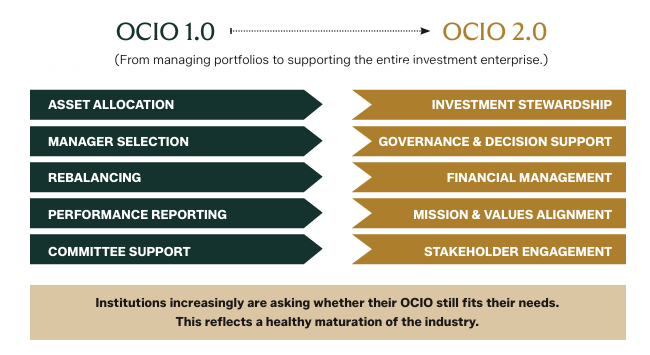
reported results were constructed and whether they fairly reflect the experience an institution could reasonably expect. - FEG believes the strongest OCIOs do more than manage the portfolio—they act as extensions of the institution, helping leaders navigate governance, communication, and the broader demands surrounding the investment program.
June 2026 marked my twentieth year working in the outsourced chief investment officer (OCIO) industry. For the past two decades, I have watched the conversation among institutions evolve from whether they should outsource investment management to whether they should reconsider the provider they already have.
When I entered the profession, the industry had not yet settled on what to call the service. Depending on the provider, terms such as delegated consulting, discretionary consulting, implemented consulting, managed portfolios, and outsourced investment management were all used to describe variations of the model. Much of the discussion centered on governance and whether outsourcing was the right fit for an institution.
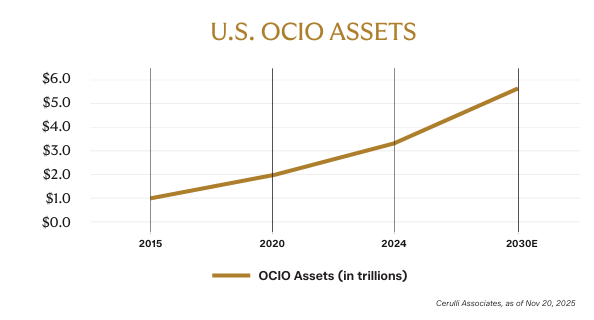
As time passed, this sub-industry of financial services moved from niche offering to mainstream acceptance. Governance models were debated. Conference panels were filled. Surveys were published. And the market largely answered the question with a resounding yes to outsourcing. Assets managed under OCIO arrangements have soared, from roughly $1 trillion in 2015 to more than $3 trillion by the end of 2024, according to Cerulli Associates.
While the industry has largely settled on the term “OCIO,” the way providers approach the role can vary considerably. OCIO models are not interchangeable. Differences in team structure, performance evaluation, investment process, philosophy, portfolio construction, transparency, and service model can all shape the client experience. As institutions become familiar with the model, these differences become more visible and more important.
In what follows, I explore several issues that institutions should consider evaluating when they’re contemplating an OCIO to OCIO transition. They reflect the questions that tend to emerge only after an institution has lived with the model long enough to understand what it truly needs from a provider.