





-01.webp?width=400)




In Brief
- The next wave of mega IPOs could be constructive over the long run, but disruptive in the near term as investors and indices adjust to these notable companies entering public markets at unprecedented scale.
- Fast-track index inclusion may help benchmarks remain relevant, but this could also turn passive investors into forced buyers before valuations, governance structures, and public-company execution are fully tested.
- For fundamental equity investors, these listings are not just short-term noise. They expand the investable universe, may reshape relative positioning, and create both risks and new entry-point opportunities.
A Different kind of IPO Cycle
The next IPO cycle will almost certainly not look like the last one. In prior eras, the reopening of the IPO window often meant a broader pipeline of companies testing public-market appetite after a period of dormancy. This time, the most consequential listings will come from a much smaller group of companies that have already reached public-market scale while remaining private. Planned listings for companies like SpaceX, OpenAI, and Databricks are representative of a larger structural shift: private markets have allowed companies to mature longer, grow larger, and delay public ownership until they are already central to the economy’s innovation narrative.
That makes the coming wave less a normal reopening than a massive transfer event. Large private companies may move into public benchmarks not as speculative newcomers, but as already systemically significant businesses.
We believe that transition could be healthy for the market ecosystem over the long term. Public markets exist, in part, to broaden ownership, deepen liquidity, support corporate growth, and give investors access to companies shaping the economy. But the path from private scale to public liquidity may not be smooth.
When IPOs Become Market-Structure Events
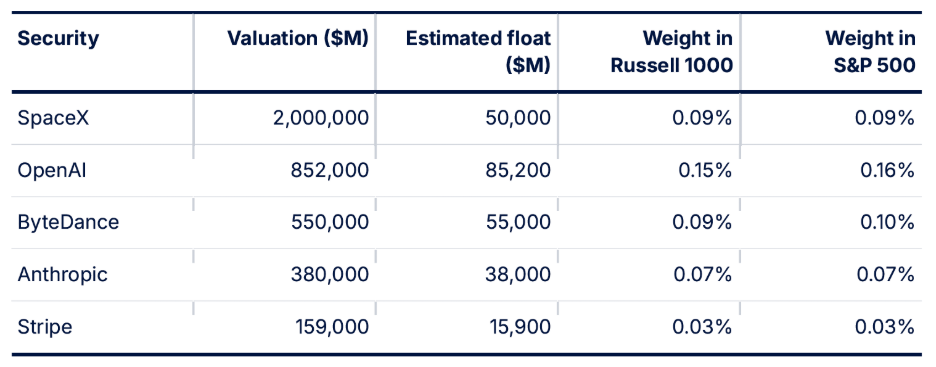
The near-term impact is likely to be mixed. On one hand, bringing these large, mature companies into the public markets will expand the investable universe. It can give investors a more direct way to participate in AI innovation, which is quickly becoming an important force in technological change. On the other hand, companies of this size will not arrive quietly. Current estimates place SpaceX’s valuation at roughly $2 trillion and OpenAI’s at roughly $800 billion—more than 2,000 and 1,000 times Microsoft’s valuation when it debuted on Nasdaq in 1986.
IPOs have historically been, at least principally, corporate-finance events: a company raises money, early investors gain liquidity, and the public market determines the price. But the advent of mega IPOs is different because their scale may immediately have broad effects, impacting index construction, ETF mechanics, passive flows, institutional portfolio design, and benchmark governance.
Exchanges and index providers both have incentives to adapt to the next wave of mega IPOs. A company such as SpaceX or OpenAI would attract enormous investor attention, generate significant trading activity, and strengthen the perceived relevance of the market infrastructure that captures it. Marquee listings can enhance an exchange’s brand and appeal to future issuers and investors. Index providers, meanwhile, have their own incentive to ensure that major benchmarks remain representative when newly public companies arrive at benchmark-moving scale. That helps explain why methodologies are evolving, including through rules that allow for faster inclusion without waiting for the traditional index review cycle.
S&P Index Rules Under Consideration
|
Existing rule |
Proposed mega-cap treatment |
|
12-month IPO seasoning period |
Cut to 6 months |
|
Minimum 0.10 IWF (~10% float) |
Waived for mega caps |
|
GAAP profitability requirement |
Waived for mega caps |
|
No fast-track entry for low-float mega-cap IPOs in broad market indexes |
Fast-track exception allowed |
Source: S&P Global.
Rules Under Review with Other Index Providers
|
Provider |
Main change under consideration |
|
FTSE Russell |
Explicit fast-track IPO inclusion after 5 trading days; relaxation of free-float and voting-rights requirements for mega-cap IPOs. |
|
MSCI |
Refinement of free-float adjustment methodology and treatment of low-float companies, rather than a dedicated fast-entry IPO rule. |
Source: LSEG, MSCI.
But faster inclusion carries a trade-off. It may push passive vehicles to buy before the market has fully assessed valuation, governance, disclosure quality, shareholder rights, and the company’s ability to operate under public-company scrutiny. And when that buying pressure meets limited tradable supply, the market impact can become even more pronounced.
Float, Scarcity, and Forced Demand
That is why free float, not headline valuation alone, may determine the immediate market impact. A company could debut with a trillion-dollar-plus valuation while offering only a small percentage of shares to public investors. The result is a scarcity dynamic: significant demand from investors chasing a limited supply of tradable shares.
In that environment, passive inclusion, active-manager interest, retail excitement, employee lockup dynamics, and limited float can combine to produce outsized aftermarket moves. The result may be a market in which the technical structure of the listing matters almost as much as the company’s headline valuation.
 Source: State Street Investment Management, April 2026.
What Valuation Shocks Mean for Fundamental Investors
For fundamental equity investors, any valuation shocks that occur should not be dismissed as mere technical noise. Some price pressure may be short term, driven by flows, index inclusion, or initial enthusiasm. But the implications are still fundamental. A new mega-cap listing can alter relative valuations across sectors and force investors to contrast newly public growth assets against established public incumbents. In some cases, IPO valuations may leave little room for error. In others, volatility may create attractive entry points into high-quality businesses whose prospects justify deeper analysis.
Governance questions may be equally important. Founder control is not inherently negative, and public markets already include prominent examples of companies where concentrated voting power has coexisted with substantial value creation. Meta and Alphabet, for example, show that dual- or multi-class share structures can help preserve strategic continuity, particularly in businesses where long-term investment cycles may conflict with short-term market pressure.
But those examples also underscore the trade-off. When voting power remains concentrated, public shareholders may have less influence over board composition, executive accountability, or major strategic decisions. That does not make founder-controlled companies uninvestable, but it does make governance analysis more important. If passive investors become required buyers of companies with limited float, concentrated voting power, and operating cultures shaped in private markets, public ownership should not be mistaken for public accountability.
One important nuance is that public investors may already have some exposure to several prospective mega IPOs. Large active managers, including certain Fidelity and Capital Group funds, have invested in late-stage private companies such as SpaceX, OpenAI, Anthropic, and Databricks through crossover strategies that blur the traditional boundary between public and private markets. As a result, the eventual IPO may not represent entirely new economic exposure for all portfolios. Instead, it could change the form of that exposure by replacing indirect ownership embedded within another security with direct ownership of the underlying business.
A Potential Release Valve for Venture Capital
The same dynamics that may create disruption for public-market investors could provide a needed release valve for private markets. Mega IPOs may restore a pathway that has been constrained in recent years: the ability for venture-backed companies to return capital to early investors and reconnect private-market growth with public-market liquidity.
The venture capital implications are therefore more clearly constructive. A wave of successful mega IPOs could help revive the exit channel after a long period of constrained liquidity. Distributions to limited partners have been under pressure across parts of the venture ecosystem, and IPOs can help restart the cycle as investors realize gains and new capital can be reinvested into the next generation of companies.
A handful of mega IPOs would not necessarily mean the entire venture market is healed. But they could provide important proof points. They may validate the late-stage private-market model and reestablish public markets as a viable destination for category-defining companies. In that sense, the transition could be healthy not only for public-market investors but also for the broader innovation-financing ecosystem.
A Structural Evolution, not just an Issuance Event
Public-market structure is evolving. Mega IPOs may force changes across index methodology, ETF implementation, liquidity management, and portfolio construction. That evolution is neither entirely positive nor entirely negative. It is a mixed but necessary adjustment to a market in which private companies can become enormous before public investors have a meaningful opportunity to participate in their growth.
Over the long run, we take a constructive view of companies maturing in private markets and eventually accessing public ones. Public listings can give investors a path to participate in businesses that have already shaped—and are likely to continue shaping—modern economies. But the transition may be disruptive. Investors should expect valuation shocks, governance questions, index-rule debates, and liquidity distortions along the way.
For investors, that disruption may be part of the opportunity. When structural flows and scarcity dynamics dominate the first phase of price discovery, careful analysis of fundamentals, valuation, governance, and long-term competitive position may matter more than ever. Whether these listings create short-term disruption, long-term opportunity, or some combination of both, FEG will continue to monitor how these developments influence market structure, valuation frameworks, benchmark construction, and portfolio positioning, with the goal of helping clients navigate an increasingly dynamic public equity landscape.