




-01.webp?width=400)




Long-term government bond yields have moved sharply higher across much of the developed world. In the United States, the 30-year Treasury yield recently moved above 5.3%, reaching its highest level since 2007. Long-term yields in Germany and France have reached levels not seen since the European sovereign debt crisis, while 30-year U.K. gilt yields have approached their highest in nearly three decades. Japan’s 10-year government bond yield has risen toward 3%, its highest level since 1996.1
The move higher extends beyond these markets to Australia, Canada, and other European markets. That breadth is important.
This is not simply a U.S. Federal Reserve story or a reaction to one country’s economic data. Across most major developed bond markets, investors are demanding higher compensation to lend money to governments for long periods. Understanding why that is happening and what it means for portfolios is increasingly important for institutional investors.
Long-Term Treasury Yields Have Repriced Higher
December monthly averages; August 18, 2026 shown as latest observation
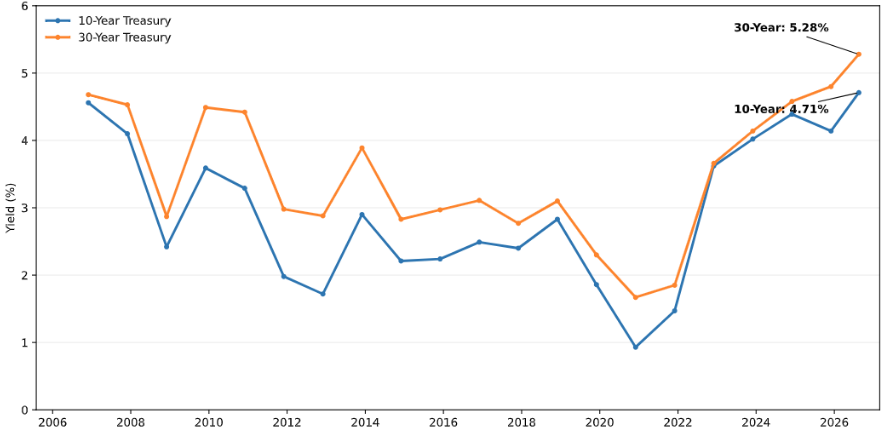
Sources: Federal Reserve Board H.15 via FRED (GS10, GS30); U.S Treasury for August 18, 2026
Why Are Long-Term Yields Rising?
Several forces are working in the same direction.
The first is inflation uncertainty. Recent increases in energy prices have reminded investors that inflation may not move smoothly back toward central bank targets. A buyer of a 20- or 30-year bond is making a very different commitment than a buyer of a two-year bond. Over several decades, there is much greater uncertainty surrounding inflation, economic growth, government policy, and the purchasing power of the income that bond will provide. Investors are therefore asking for more yield to accept higher uncertainty.
The second factor is government borrowing. The fiscal deficit remains large in the United States, while governments in Europe, the U.K., Japan, and elsewhere face substantial financing needs related to existing debt, defense spending, infrastructure, aging populations, and other policy priorities. More government borrowing means more bonds must ultimately be purchased by investors.
At the same time, one of the largest sources of demand for government bonds over the past 15 years has diminished. Central banks are no longer buying bonds through quantitative easing at the extraordinary pace that followed the global financial crisis and the pandemic. Put simply, substantial government financing needs must increasingly be absorbed by private investors at a time when price-insensitive central-bank demand has diminished. The U.S. treasury’s recently expanded buyback program, announced on August 19, may improve liquidity in older long-dated securities and temporarily reduce the amount of duration the market must absorb, but it does not materially reduce the U.S. government’s underlying financing needs. The maturity composition of that borrowing can influence where pressure appears along the yield curve, but the broader need for private capital remains.
The bond market is responding the way markets generally do: prices have fallen, and yields have risen until investors are willing to absorb the additional supply.
Japan Makes the Global Story Particularly Important
Japan may be the clearest example of how much the interest-rate environment has changed. For decades, Japan operated with extremely low or negative interest rates while the Bank of Japan purchased enormous amounts of government debt. Japanese investors searching for income became major buyers of bonds outside Japan, including U.S. Treasuries and European government securities. That environment is changing.
Japanese government bond yields have risen dramatically as the Bank of Japan has moved away from the policies that held interest rates near zero. Japan’s 10-year yield is now near levels last seen roughly 30 years ago.
That matters globally because a Japanese pension fund, bank, or insurer that can earn meaningfully more on bonds at home has less incentive to buy foreign bonds, particularly after accounting for currency-hedging costs.
The same basic issue applies elsewhere. Rising yields in one large bond market can make bonds in another market less attractive unless their yields rise as well. This is one reason long-term interest rates increasingly appear to be moving in tandem with a global repricing, rather than as a series of unrelated domestic events.
Japan's 30-Year Round Trip in Interest Rates
Year-end monthly averages, with September 1996 and August 18, 2026 highlighted
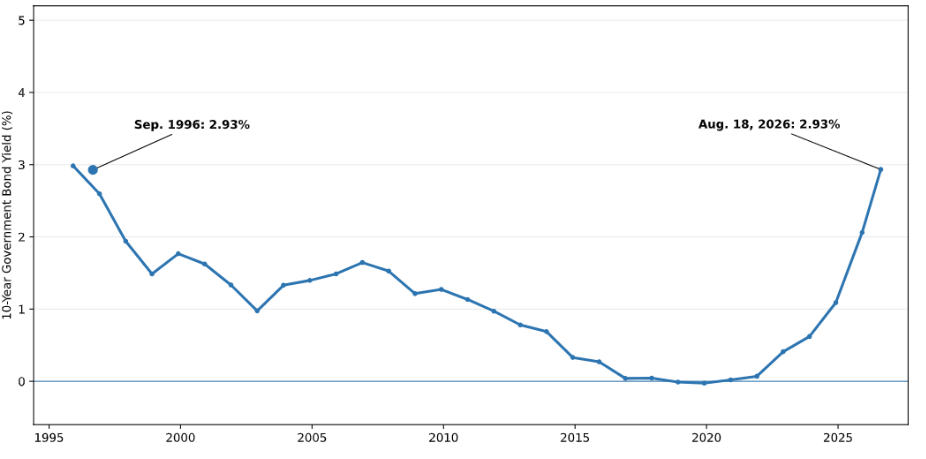 Source: OECD Main Economic Indicators via FRED (IRLTLT01JPM156N); Japan Ministry of Finance for August 18, 2026
Higher Yields Are Not Necessarily Bad News
The increase in yields has created losses for investors already holding long-duration bonds. But for investors putting money to work today, higher yields are also creating a significantly better fixed income opportunity set.
For much of the period following the global financial crisis, high-quality bonds offered yields well below historical norms. Investors often had to move into longer maturities, lower-quality credit, or less-liquid strategies to earn acceptable yields. Today’s environment is quite different.
Treasuries, agency mortgage-backed securities, and high-quality corporate bonds now provide substantially more income than they did several years ago. Investors can earn meaningful yields without moving as far out on the risk spectrum.
This improves the prospective return on traditional fixed income and restores something that had largely disappeared during the ultra-low-rate period: income itself can once again do much of the work.
But Higher Yields Do Not Mean Investors Should Maximize Duration
The key question to ask in the current environment is whether investors are being adequately compensated for the additional risk of owning long-dated bonds.
A 30-year Treasury bond carries considerably more interest-rate sensitivity (i.e., duration) than an intermediate Treasury bond. If yields rise further, the price decline on the longer bond can be much larger.
That additional risk may be appropriate for a pension plan matching a long-dated liability or for an investor deliberately seeking significant exposure to falling interest rates. But it is not necessarily the best way for most institutional investors to take advantage of today’s improved bond yields.
This is where the current opportunity becomes particularly interesting. Investors no longer have to take extreme duration risk to earn meaningful yields.
The intermediate portion of the bond market provides much of the yield improvement while taking substantially less interest-rate risk than the 20- and 30-year sectors. It also retains enough duration to provide meaningful diversification if economic growth weakens and interest rates ultimately decline.
That balance of income, quality, liquidity, and moderate interest-rate sensitivity is becoming increasingly valuable, and importantly, it can be found in traditional core fixed income portfolios.
Why Core Fixed Income Matters More Today
For institutional investors, this environment reinforces the value of maintaining a meaningful allocation to core fixed income. A traditional core fixed-income portfolio generally invests across high-quality U.S. Treasuries, government-related bonds, agency mortgage-backed securities, and investment-grade corporate bonds. It typically maintains an intermediate level of interest-rate sensitivity rather than concentrating exposure in very short- or very long-maturity securities. Those characteristics are particularly useful today.
First, high-quality fixed income now offers materially higher all-in yields. Investors can generate meaningful income without relying as heavily on lower-quality or less liquid assets.
Second, intermediate duration offers balance. Core portfolios retain enough interest-rate exposure to potentially benefit if growth slows and yields eventually decline, without assuming the much greater volatility embedded in the longest-maturity bonds.
Third, liquidity remains valuable. Public core bonds can generally be sold or rebalanced quickly, giving institutional investors a source of capital that can be redeployed when equity or credit markets become dislocated.
Finally, core fixed income can once again generate return while performing its traditional portfolio role. During the ultra-low-rate era, investors often viewed the diversification benefits of core bonds as something they had to accept despite very low expected returns. At today’s higher starting yields, income and portfolio defense are much better aligned.
Where We Land
The recent rise in global sovereign yields should not be interpreted as a signal to abandon duration, nor should today’s higher yields be viewed as proof that the longest-maturity bonds have become an obvious buying opportunity.
The more defensible institutional posture is to recognize that the strategic value of high-quality bonds has improved materially, while the risk/reward for duration appears more attractive in the intermediate and 10-year portions of the curve than at the very long end.
Long duration continues to have an important role for liability matching and as protection against a severe recession or deflationary shock. However, long bonds can be significantly more volatile.
For most institutional investors, that makes a well-diversified core fixed income allocation particularly compelling.
Core fixed income provides exposure to today’s higher yields without requiring investors to make an aggressive forecast about where long-term interest rates are headed. It emphasizes the higher-quality parts of the bond market and preserves the potential diversification benefits fixed income is intended to deliver when risk assets struggle.
The broader message from the global rise in yields is therefore not that investors should take more interest-rate risk simply because long bonds now yield more. The basic economics of high-quality fixed income have improved considerably, strengthening the strategic case for core fixed income.
1 Market data as of August 18, 2026