










The 2026 midterm elections delivered a decisive shift in Washington, with Democrats regaining control of both chambers of Congress. The results set the stage for divided government during the final two years of President Trump's term, potentially reshaping debates over taxes, spending, and regulatory policy. For investors, however, the more important question is whether election outcomes should influence long-term portfolio allocations. History suggests caution before making that leap.
Markets React to a Changing Political Landscape
Financial markets wasted little time responding to the election. On November 5, the S&P 500 declined 4.4%, while semiconductor stocks fell more than 12%. Concerns about potential restrictions on data center development added to existing questions about the pace and profitability of artificial intelligence (AI) investment. For the week, the equal-weighted S&P 500 outperformed its capitalization-weighted counterpart, highlighting the concentrated pressure on larger technology-related companies.
The election also expanded Democratic influence beyond Washington, particularly in states where many decisions that will affect data center development will be made. Greater scrutiny could affect the pace of AI investment, while Congress may revisit federal tax incentives. Meanwhile, uncertainty surrounding the Strait of Hormuz remains a risk to energy markets. These developments warrant attention, but broader market performance depends on considerably more than political control.
History Offers Perspective, Not Predictions
Despite the political uncertainty surrounding elections, historical equity market performance offers some perspective. According to Baird Strategas, the S&P 500 has not experienced a negative 12-month price return following a midterm election since 1938, with an average gain of 14.8%.
Perhaps more importantly, stocks have historically performed well under different political arrangements. Strategas research covering 1933 through 2025 shows positive average annual S&P 500 returns across all six combinations of presidential and congressional party control examined. While individual sectors have responded differently to changes in Washington, neither political party has held a monopoly on favorable equity market performance.
Historical averages are not guarantees. Over time, economic growth, corporate earnings, and valuations matter more to investment outcomes than which political party holds office.
Staying Disciplined When Volatility Returns
Last week's market decline also provides a reminder that recoveries from sharp selloffs are rarely smooth. FEG's analysis of previous S&P 500 daily declines of at least 4% found a median return of 14.3% over the subsequent 12 months. Yet further weakness was common, and approximately one-third of those 12-month periods produced negative returns.
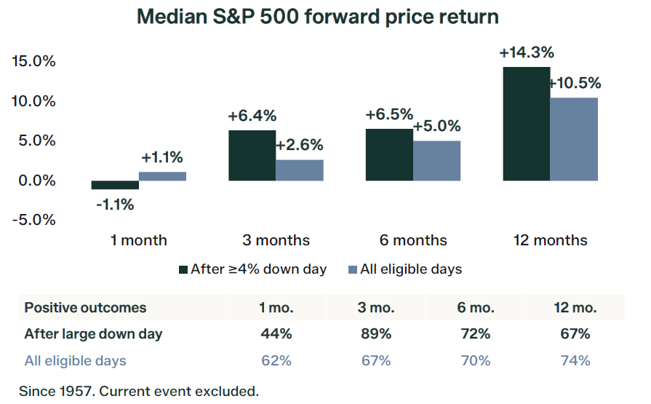
Data source: FactSet. First daily loss equal to or more than 4% after 63 sessions (roughly 3 months) without an 4% or greater decline.
The lesson is not that investors should anticipate a rebound following the latest decline. Rather, short-term market volatility can create opportunities for disciplined rebalancing while reinforcing the importance of diversification and appropriate liquidity.
Elections matter, and changes in government policy can influence individual industries and investment opportunities. But institutional portfolios should be guided by long-term objectives, not election results. Investors are generally better served by maintaining a thoughtful strategic allocation than attempting to position portfolios around which political party controls Washington.